Queen Anahita platform worldwide

The Persian father of painting
Mani , a Persian artist
PERSIAN ARTISTS
John Williams
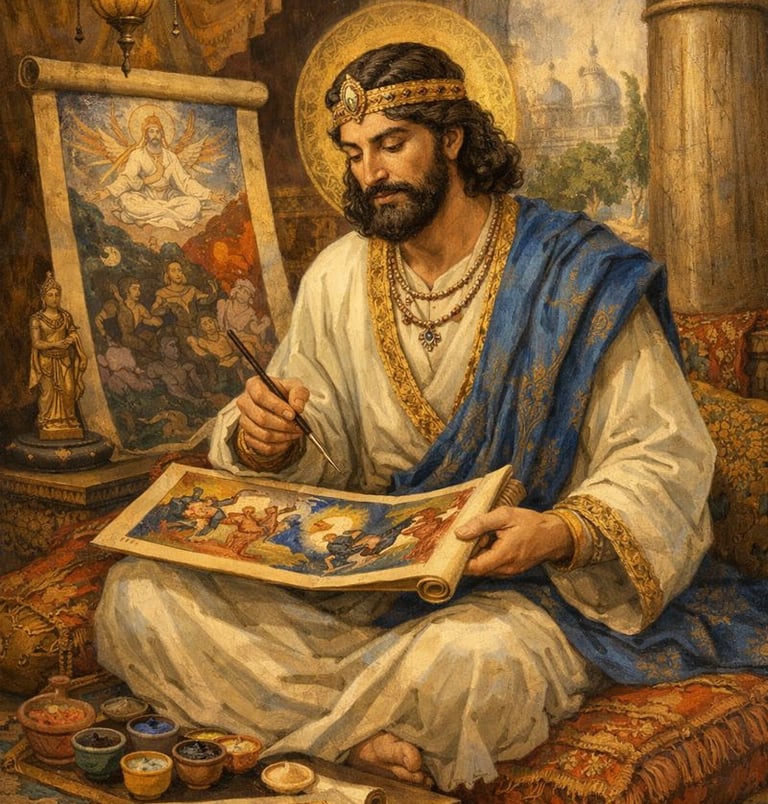
Mani (c. 216–274 CE)
Founder of Manichaeism · Sassanian - Persian Painter · Visionary
Historical Context
Era: 3rd century CE
Empire: Sassanian Persia
Reign during his life: Shahpur I (initial patron)
Cultural setting: A world of theology, imperial symbolism, and sacred kingship
I imagine Mani first as a quiet presence, not announcing himself like a courtier, but moving with the patience of someone who believes time will listen. It is the third century of the Common Era, and Sassanian Persia stands at the height of its confidence—stone reliefs carved for kings, fire temples glowing with ritual permanence. In this world, images serve power. Mani dares to present his art.
Historical records tell us Mani was welcomed into the court of Shahpur I, a ruler unusually open to ideas. Yet Mani was no entertainer of royalty. He was a visionary who believed that revelation, if left only to words, withered. Zoroastrian priests argued doctrine through speech and flame; Mani responded with form and color. He painted cosmology itself—Light descending, Darkness resisting, the human soul caught between them. These images were not embellishments. They were doctrine.
The Arzhang was his painted book, now lost, was described by contemporaries as essential to Manichaean teaching. This is crucial. Mani did not illustrate scripture; he made painting scripture. As a curator, I find this moment radical. Mani elevated visual language to theological authority centuries before illuminated manuscripts became common. He understood what museums still wrestle with today: images bypass resistance to fascination. They enter quietly and stay.
Personally, I reconstruct his work through later Manichaean manuscripts found in Central Asia and China. Flat planes of color. Clear contours. Figures arranged by spiritual hierarchy, not physical realism. These choices were intentional. Mani painted ideas, not appearances. In doing so, he laid a foundation for a visual logic that would echo much later in Persian miniature painting—clarity, symbolism, narrative precision.
But history is rarely kind to those who innovate too boldly. After Shapur’s death, political winds shifted. Under Bahram I, Mani was imprisoned. Sources differ on his death, but they agree on this: even in confinement, he taught. Even stripped of brush and pigment, his vision endured. His followers carried his pictorial theology eastward along the Silk Road, where fragments of his visual system survive today in museums, mislabeled sometimes as anonymous religious art— which I count it as injustice to the identity of those artistic designs and paintings.
As a curator, I am struck not only by what Mani created, but by what was taken from us. No signed panel. No surviving original page. And yet, unlike most Persian painters of that era, we know his name. That alone tells us how powerful his presence was. Empires tried to erase him; but the Persian tradition preserved him.
Mani reminds us that art history is not merely a lineage of styles—it is a record of courage. He believed images could save souls. Whether one shares his theology is irrelevant. His legacy is this: in Persia, long before now, a painter stood and said that a visible art could be sacred. And in that declaration, he changed the future of art forever.
Queen Anahita Gallery
© 2024. All rights reserved.